
The clinical centre of gravity in Alzheimer’s disease (AD) shifted in 2023 and 2024 with the arrival of two anti-amyloid antibodies — lecanemab and donanemab — that demonstrated modest but real disease-modification effects against the amyloid cascade (Cummings et al. 2023; Rabinovici et al. 2025). Their approval ended a long decade of debate about whether the cascade hypothesis was the right place to intervene at all.
It also reframed the next question. With anti-amyloid now in routine practice, and the magnitude of clinical benefit clear but bounded, the obvious next-generation conversation in AD target discovery centres on the cell types that respond to and modulate amyloid pathology — and on the surrounding neuroinflammatory environment. That is the microglia conversation. This post walks through what the Euretos AI Platform surfaces on that axis.
Three lines of evidence converged in the mid-2010s to put microglia at the centre of the AD genetic-architecture conversation. First, GWAS for late-onset AD identified an enrichment of risk variants in genes preferentially expressed in microglia and other myeloid cells: TREM2, CD33, ABCA7, INPP5D, and several more. Second, common and rare TREM2 variants were associated with substantial AD risk, and TREM2 turned out to be a near-microglia-specific gene whose protein product was directly involved in microglial sensing of pathological amyloid. Third, single-cell RNA sequencing of mouse and human AD brain identified a state-shift in microglia, away from a homeostatic transcriptional programme into reactive states associated with pathology.
A widely-cited review of the single-cell microglia work in AD describes four reactive microglial signatures that have been characterised in detail: disease-associated microglia (DAM), interferon-microglia, MHC-II microglia, and proliferating microglia (Chen & Colonna 2021). The DAM signature is the most consistently observed across mouse models of neurodegeneration, including AD models; the proposal in the field has been that all reported microglial populations are either one of these four or some combination, depending on the clustering strategy and the disease model.
That review also describes how single-nucleus RNA-sequencing of human AD brain has produced patterns that are similar but not identical to the mouse signatures. Where the mouse and human patterns diverge is itself a target-discovery question — which microglial states in human AD are conserved from the mouse models, and which are uniquely human?
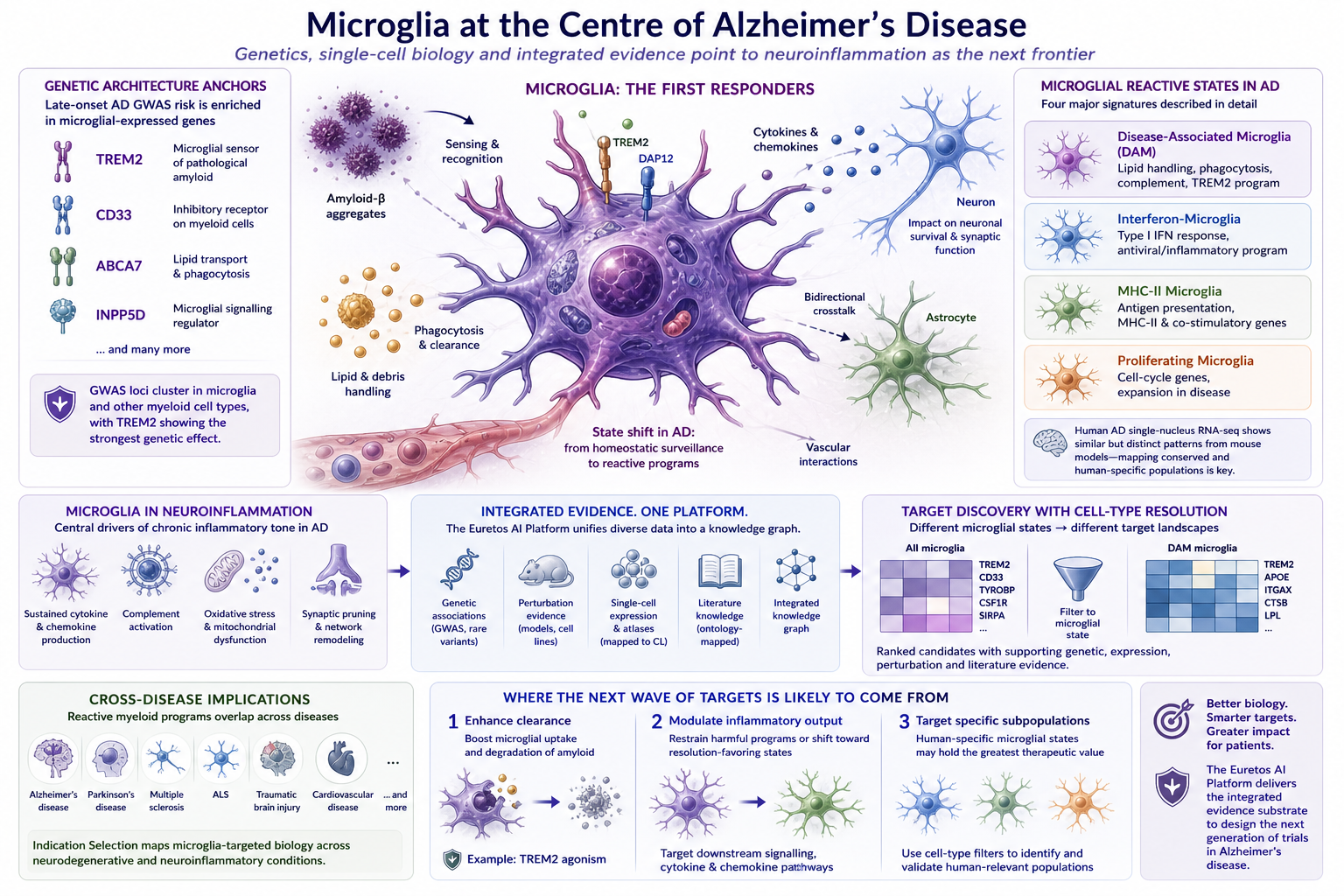
The Euretos AI Platform integrates the relevant evidence streams into one queryable knowledge graph: AD genetic-association data (the AD GWAS catalogue, including the microglia-enriched risk loci), gene-level perturbation evidence from microglial cell-line and mouse-model experiments, single-cell expression atlases of AD brain mapped to the cell-ontology, and the published literature anchored to common ontology terms.
A target-discovery query against AD that is restricted to microglia returns a different ranked candidate list than a query against AD across all brain cell types. The list is dominated by genes implicated in microglial activation and sensing — the TREM2-DAP12 sensing complex, the components of the DAM transcriptional programme, the chemokine and cytokine genes by which microglia communicate with adjacent neurons and astrocytes, and the lipid-handling and lysosomal-clearance genes that distinguish the reactive states.
A query restricted further to a specific reactive microglial state — DAM, interferon-microglia, MHC-II microglia — returns yet another shortlist. This is where the integration of the platform’s cell-type catalogue with the published single-cell atlases earns its weight: a researcher does not need to re-derive the DAM signature, re-cluster published data, or write the ontology mapping themselves. The mapping is in the platform; the query is direct.
Microglia are not the only cell type in the AD neuroinflammatory environment. Astrocytes, infiltrating peripheral myeloid cells, and CNS-resident vasculature all contribute to the chronic inflammatory tone that interacts with amyloid and tau pathology. What microglia provide to target-discovery work is the strongest individual genetic anchor — the AD GWAS loci sit disproportionately in microglial-expressed genes — and a relatively well-characterised single-cell state space.
The cross-disease implication is that microglial activation programmes overlap with reactive-myeloid states seen in other neurodegenerative and neuroinflammatory contexts. Reviews of microglia-mediated neuroinflammation describe overlapping reactive states in multiple sclerosis, Parkinson’s disease, ALS, traumatic brain injury, and even cardiovascular conditions where peripheral neuroinflammation contributes (Wang et al. 2022). For target-discovery work, this opens the Indication Selection question: a microglia-targeted candidate that scores well in AD may also be ranked well in adjacent neuroinflammatory diseases, and the platform’s cross-disease evidence map surfaces that landscape directly.
Three working hypotheses currently compete in the microglial-AD literature, and the AI Platform’s view of each is increasingly informative.
The first is that enhancing microglial uptake and clearance of amyloid — TREM2 agonism is the clinical example — produces additive benefit on top of anti-amyloid antibodies. The integrated platform view of TREM2 returns a strong genetic anchor, a clear microglial expression profile, and a coherent perturbation pattern.
The second is that modulating the chronic inflammatory output of reactive microglia — restraining the DAM programme, or shifting it toward a resolution-favouring state — will protect adjacent neurons from secondary damage. Candidate targets here are more diverse, sit further into the downstream signalling cascades, and benefit most from the platform’s cross-cell-type integration.
The third is that specific microglial subpopulations are the relevant therapeutic targets, rather than microglia as a class. Where mouse and human single-cell atlases diverge, the human-specific populations may matter most for drug development. The platform’s cell-type filter is the analytical tool for asking that question.
The clinical answer will play out in trials over the next several years. The integrated evidence view that the AI Platform provides is the analytical substrate for designing those trials.
Sources cited based on articles retrieved from PubMed.
Chen & Colonna 2021 — Microglia in Alzheimer’s disease at single-cell level, J Exp Med
Cummings et al. 2023 — Lecanemab Appropriate Use Recommendations, J Prev Alzheimers Dis
Rabinovici et al. 2025 — Donanemab Appropriate Use Recommendations, J Prev Alzheimers Dis
Wang et al. 2022 — Microglia-Mediated Neuroinflammation, J Inflamm Res
.svg)