This is the third in our annual review of FDA novel-drug approvals on the Euretos blog. Last year we observed that 2024 was another strong year by the volume of approvals and by the diversity of mechanisms; the year before, that 2023 was one of the best in decades. The pattern has held into 2025. Through mid-December the FDA’s Center for Drug Evaluation and Research has approved 39 novel agents, a pace consistent with the prior two years. The spread of mechanisms is, if anything, broader.
Five themes are visible across the year’s approvals.
Targeted oncology by a defined molecular biomarker has been the most prolific category in 2025. The pattern is by now familiar: a clearly defined patient subgroup, a target with established mechanism, and a small molecule or biologic engineered for the specific lesion.
ROS1-rearranged non-small-cell lung cancer received taletrectinib (June 2025). EGFR exon-20-insertion NSCLC received sunvozertinib (July 2025). HER2-mutant NSCLC received zongertinib (August 2025) and sevabertinib (November 2025). Estrogen-receptor-positive, ESR1-mutated breast cancer received imlunestrant (September 2025), an oral selective estrogen receptor degrader. NPM1-mutated and KMT2A-rearranged acute myeloid leukaemia received ziftomenib (November 2025, a menin inhibitor) the second drug in that class to reach approval.
The integrated-evidence platform view of these approvals is consistent. In each case, a target-discovery or target-validation question of the kind the Euretos AI Platform supports, was the analytical work upstream of the trial. It surfaced the genetic anchor, weighed the perturbation evidence, and restricted to the relevant tumour-cell context. The answers were not always obvious in 2015. By 2025 they are operational.
The ADC platform continued its expansion in 2025. Datopotamab deruxtecan (January 2025) targets TROP2 in HR-positive, HER2-low/negative breast cancer. Telisotuzumab vedotin (May 2025) targets c-Met in non-squamous EGFR-wildtype NSCLC, with c-Met overexpression as the selection biomarker. The pattern in both is the same: a tumour-restricted surface antigen, an internalisation-competent target, a payload chemistry matched to the disease context.
Bispecific T-cell engagers continued the move into solid and haematological tumours that tarlatamab demonstrated last year. Linvoseltamab (July 2025) is a BCMA-directed bispecific for relapsed/refractory multiple myeloma, joining a maturing set of BCMA-targeted approaches in this disease.
For target-discovery work in oncology, the architectural question raised by these approvals is a familiar one. Tumour-restricted surface antigens with the right internalisation behaviour for ADC, the right pairing geometry for bispecifics, and the right tumour-vs-normal expression profile are not abundant. The Euretos AI Platform’s cell-type-resolved expression view and cross-disease landscape make the search for the next generation of these antigens analytically tractable.
Two approvals in IgA nephropathy in 2025 : atrasentan (April 2025), an endothelin-A receptor antagonist, and sibeprenlimab (November 2025), an APRIL-targeting monoclonal that reduces IgA pathogenicity at its source. They bring the standard-of-care conversation in this disease forward considerably. Sparsentan was approved last year on the same axis. The biology of IgA nephropathy involves three connected layers. Pathogenic IgA production, glomerular deposition, and the downstream haemodynamic and inflammatory response. and the 2025 approvals act on different layers of that cascade.
Indication Selection work is the inverse of target discovery. Asking which patient population a target should pursue, with IgA nephropathy as an instructive example. A target with an established role in either the upstream B-cell biology or the downstream renal-haemodynamic response has multiple plausible routes into clinical development in this disease, and several adjacent renal indications worth considering through the same evidence map.
Several first-in-class approvals in 2025 sit outside oncology and outside the precision-medicine frame.
Suzetrigine (January 2025) is the first NaV1.8-selective sodium-channel inhibitor approved for moderate-to-severe acute pain. This non-opioid mechanism has been pursued for two decades and reached approval against the highest possible regulatory bar. Nerandomilast (October 2025) is a phosphodiesterase-4B inhibitor for idiopathic pulmonary fibrosis. It is the first new mechanism in IPF since pirfenidone and nintedanib, and a return to translational-research questions in this disease that we explored on the blog in April. Sebetralstat (July 2025) is the first oral plasma-kallikrein inhibitor for on-demand treatment of hereditary angioedema attacks. Elinzanetant (October 2025) is a non-hormonal NK-1/NK-3 receptor antagonist for vasomotor symptoms in menopause.
Each of these reaches approval in a category where the prior decade produced more failures than successes. The honest framing is that primary-data-anchored target work, sustained patiently over many years, eventually produces approvals that were not predictable in any one year along the way.
Genetics-anchored programs in rare disease continued the pattern of the prior two years. Mirdametinib (February 2025) is a MEK inhibitor for NF1-associated symptomatic plexiform neurofibromas. Fitusiran (March 2025) is an RNAi therapy that lowers antithrombin to rebalance haemostasis in haemophilia A and B. Sepiapterin (July 2025) treats phenylketonuria via tetrahydrobiopterin pathway support. Elamipretide (September 2025) is a mitochondrial-targeted peptide approved for Barth syndrome. Plozasiran (November 2025) is an APOC3-targeting siRNA for familial chylomicronemia syndrome.
The modality spread across these is wide: small molecule, mitochondrial peptide, two siRNAs, and an antisense-mechanism enzyme. The genetic anchor in each case is well-defined. For Indication Selection work in a target with a strong rare-disease association, the precedent that a precision approach can clear regulatory bar in patient populations of a few hundred or a few thousand patients is now well-established.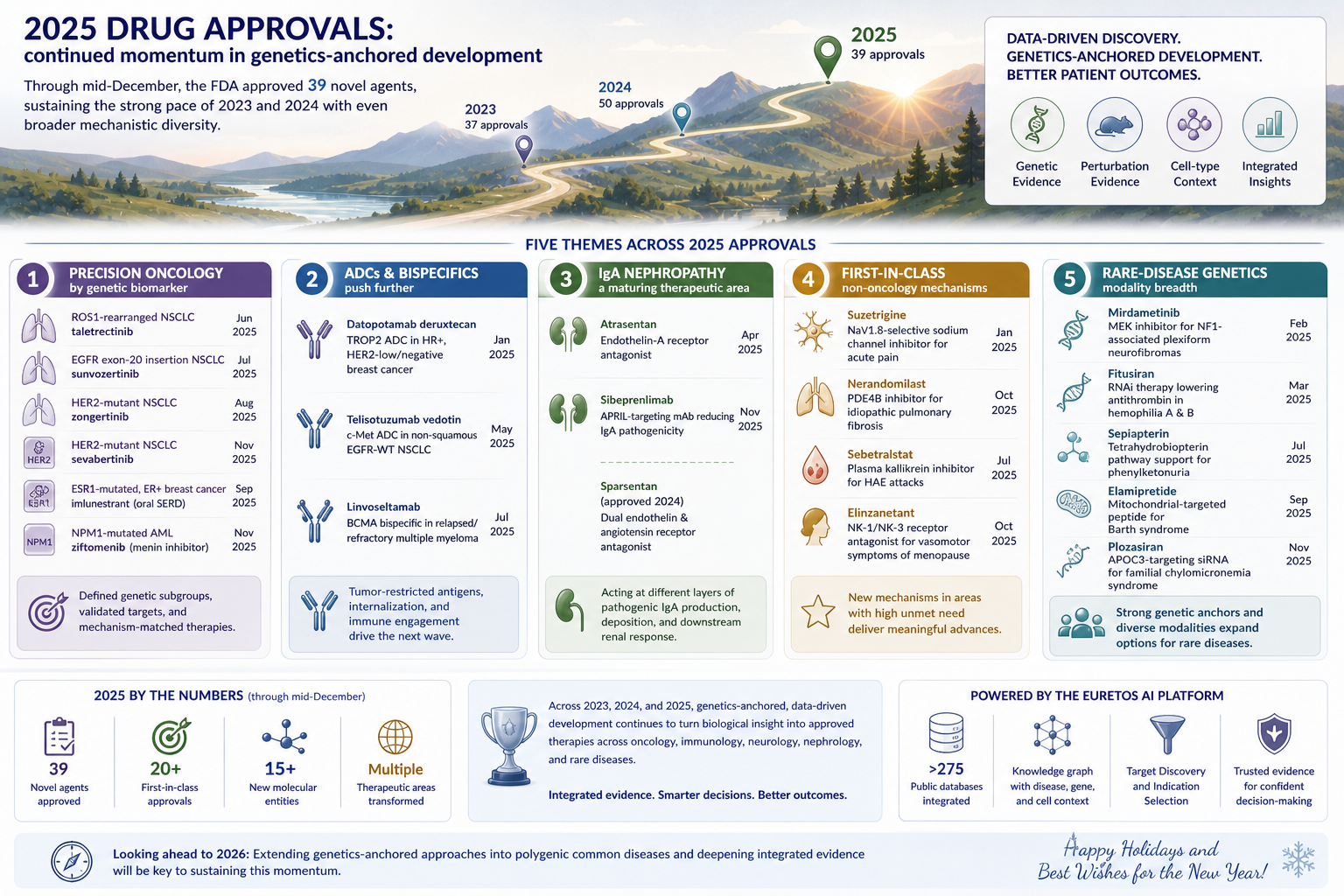
Across 2023, 2024, and now 2025, the trend is consistent: novel mechanisms reach approval more often when the program was anchored in primary biological data: genetics, perturbation, and integrated evidence, rather than literature volume alone. The breadth of modalities reaching approval is wider than at any point in the past decade. The diseases reaching new mechanisms include both the well-funded common indications and the small rare-disease populations.
That has always been the working hypothesis behind the Euretos AI Platform, and the past three years of approvals have been a quiet empirical reinforcement.
The 2026 conversation, which will play out across the next twelve months, is likely to focus on whether the genetics-anchored approach extends into the polygenic common diseases where the genetic architecture is more fragmented, and on what additional integration is needed to keep the trajectory going. The platform’s research customers will, as ever, ask first.
.svg)