Understand disease biology. From mechanism to target.

The Disease Atlas is the navigable, evidence-graded map of disease biology, built from primary biological data, resolved to cell type, revealing candidates and mechanisms that literature-driven tools cannot surface. It integrates causal genetics, perturbation biology, network evidence and single-cell expression data across 34,000 diseases and phenotypes and 3,500 cell type samples.

From disease understanding to defensible conclusions

Designed for translational researchers in disease biology exploration, target discovery, target assessment, and indication expansion. Every workflow is grounded in the same causal evidence base, at the cellular resolution where disease biology operates.

Disease biology resolved to the cell types where it operates
Novel target candidates surfaced by biology, not by literature
Target assessment on biology, direction of effect, therapeutic modality and safety
Your proprietary data evaluated in the full context of disease biology

See where the disease operates before you consider any target candidate

The Disease Atlas starts with the disease itself. An interactive anatomical map shows which cell types drive the disease, colour-coded by disease specificity and impact score, from organ to tissue to cell type. Every view in the platform — ranked candidates, expression data, genetic evidence, driver analysis — is resolved to the cell type context you select. The biology sets the frame; everything else follows from it.

Review target candidates ranked on causal and molecular evidence

Every protein-coding gene is ranked per disease across five scored dimensions: biology, development, druggability, safety and literature. The score is fully decomposed: you see what drives each candidate's rank, not just the number. Direction of effect is explicit: inhibit, activate, or exploit synthetic lethality, across small molecule, mAb, ADC, bispecific and T-cell engager modalities. Safety risks across cardiac, hepatic, CNS, pulmonary, renal and immune systems are assessed for every candidate. You can reorder by any dimension.

The target score has a very strong validation against clinical outcomes: 99.4% of approved drug targets rank in the top 1%. Top-ranked targets are twice as likely to succeed in clinical trials (analysed across 2,587 Phase 2 and Phase 3 trials).

Build a complete and defensible rationale for any target candidate

Select any candidate from the ranked list and open a six-panel assessment covering everything needed to defend a programme decision.
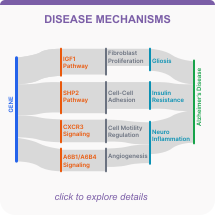
Disease Mechanisms

Disease Mechanisms

See how a gene connects to disease, layer by layer — from pathway to cellular function to tissue to phenotype. Every connection traced to its biological source.
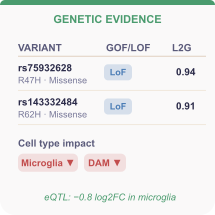
Genetic Evidence

Genetic Evidence

Specific variants with consequence type and direction of effect. eQTL resolved to the disease-relevant cell type, not whole tissue. GOF/LOF classification explicit.
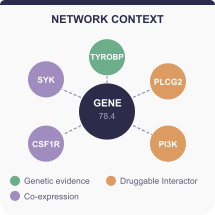
Network Context

Network Context

The immediate interaction neighbourhood of the candidate, colour-coded by disease-associated genetic evidence, druggable interactors and co-expression partners.
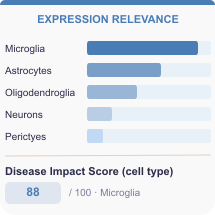
Expression Relevance

Expression Relevance

Expression levels across disease-relevant cell types, ranked by disease impact score. Contextual evidence — shown for what it is, not overclaimed as causal.

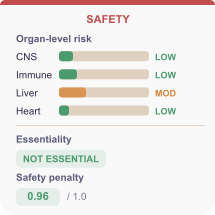
Safety

Safety

Organ-level safety across six systems: cardiac, hepatic, CNS, pulmonary, renal and immune. Observed and predicted risk distinguished. Essentiality scored separately.
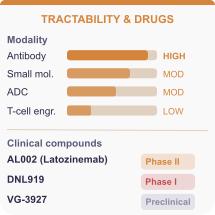
Tractability & drugs

Tractability & drugs

Modality-specific tractability scores from quantitative biological data. Directional therapeutic hypothesis per modality. Clinical compounds with development stage and indication.

 
tevalogo
"I find the Euretos platform to be valuable in what it offers in terms of advanced AI capabilities and analytics of smart scouting and literature searches to probe relevant targets, indications, and therapeutics. The professional support and dedicated mentoring from experienced bioinformatics professionals that Euretos offers greatly enhances our ability to take advantage of all the capabilities of the platform, and extract meaningful insights for our day-to-day mission of bringing innovation into Teva."
 
Dr. Dana Bar-On - Sr. Director, Head of Academic Affairs and Networks, Specialty R&D, Teva  Pharmaceuticals. 
 

Explore all disease evidence in one view

The evidence radial brings together six categories of disease data — literature, genetic variants, expression, drug targets and more — in a single interactive view. Each segment shows the volume of evidence in that category. Select a cell type on the anatomical map and the radial recalculates instantly, showing which evidence is relevant to that specific cellular context.

Explore all disease evidence in one view

The evidence radial brings together six categories of disease data — literature, genetic variants, expression, drug targets and more — in a single interactive view. Each segment shows the volume of evidence in that category. Select a cell type on the anatomical map and the radial recalculates instantly, showing which evidence is relevant to that specific cellular context.

Zoom in on disease pathologies

Select a cell type and every evidence category updates to that specific biological context. Detailed information and filtering options are available for each category. Gene sets of interest can be saved directly or connected to candidate ranking and disease driver analysis.

Uncover the mechanisms that drive disease pathology

Disease driver analysis reveals which biological mechanisms underlie your disease by enriching any gene set against nine structured driver categories including pathways, cell functions, organ functions and phenotypes. The analysis runs against the most disease-relevant cell type as the biological background, making results relevant. Genes associated with the highest number of drivers represent the strongest biological signal and can be saved directly as candidates for further assessment.

Apply the full disease context to your own data

Upload any gene set and evaluate it against the complete disease evidence base. In this example, a set of 350 genes from a high-throughput screen is uploaded and opened directly in the Disease Atlas. Each evidence category in the radial immediately shows which genes in the set have disease literature support, which are upregulated in the disease, and which carry disease-associated variants. The target prioritisation score is applied to every gene in the set, giving you an immediate, evidence-graded view of your own candidates in full disease context.
Client review

Target Discovery

"We worked with Euretos to leverage their AI capabilities with the aim of finding new targets in two different indications. It was a real pleasure to work with them and the whole process was characterized by transparency, their willingness to listen to our needs and suggestions, and swift responses and data delivery. In addition, we found their platform very useful for getting an overview of the different targets and for general queries."

Tau Benned-Jensen
Senior Research Scientist, H. Lundbeck A/S
Client review

Indication selection

“In this project, we evaluated you against our internal investigations and the results of one other external provider. What really sets you apart is how you combine a fundamentally biological and data-driven approach. The breadth of the indications you assess and the depth of your analysis sets you apart and is a clear value add to our internal capabilities.”

Large European Pharma
Global Head
Client review

Target Assessment

"I find the Euretos platform to be valuable in what it offers in terms of advanced AI capabilities and analytics of smart scouting and literature searches to probe relevant targets, indications, and therapeutics. The professional support and dedicated mentoring from experienced bioinformatics professionals that Euretos offers greatly enhances our ability to take advantage of all the capabilities of the platform, and extract meaningful insights for our day-to-day mission of bringing innovation into Teva."

Dr. Dana Bar-On
Sr. Director, Head of Academic Affairs and Networks, Specialty R&D, Teva Pharmaceuticals
Client review

Target Discovery

"We have been working with Euretos for many years now. They provide us with unique tools that we use as an integral part of our target discovery and validation. Using the Euretos AI platform is a mandatory input to our target discovery meetings."

Large European Biotech
Director Target Discovery
Client review

Indication Selection

"We find that the Euretos group was very easy to work and communicate with. The professional staff at Euretos did a great job extending their platform and capabilities to our advantage. Euretos helped us to extract meaningful information from a highly complex data domain, that we could build on internally."

Henriette Husum Bak-Jensen
Project Manager, Projects & Portfolio department, H. Lundbeck A/S
Client review

Target Assessment

"We are fascinated by the suggested hypothesis. It was great that even very small expressional changes were captured and a hypothesis was generated. The interpretation was also convincing and consistent. Also, the team is well engaged, and had a very good understanding in the background of the project and our research question"

Large Japanese Pharma
Principal Scientist

Data-driven disease insights